Every figure in this article account numbers, deposit totals, insurance cover, overdraft limits is cross-checked against Press Information Bureau (PIB) releases and the official PMJDY portal. We link directly to government sources at the end so you can verify everything yourself before you apply.
| Parameter | Details |
|---|---|
| Full Scheme Name | Pradhan Mantri Jan Dhan Yojana (PMJDY) |
| Also Known As | National Mission for Financial Inclusion (NMFI) |
| Launched On | 28 August 2014 |
| Launched By | Prime Minister Narendra Modi |
| Ministry | Ministry of Finance, Department of Financial Services |
| Motto | “Mera Khata – Bhagya Vidhata” (My Account – Creator of Good Fortune) |
| Who Can Apply | Any Indian citizen aged 10 years or above |
| Minimum Balance | Zero (no minimum balance required) |
| Total Accounts (as of July 2026) | Over 58.6 crore |
| Total Deposits (as of July 2026) | More than ₹3.08 lakh crore |
| Official Website | pmjdy.gov.in |
| Application Fee | Free no charges at any stage |
Table of Contents
- What Is PMJDY?
- Objectives of the Scheme
- Key Features & Benefits
- Growth of PMJDY Since 2014
- Eligibility Criteria
- Documents Required
- How to Open a PMJDY Account
- Overdraft & Insurance Cover Explained
- Common Mistakes to Avoid
- Pros & Cons
- Frequently Asked Questions
- Quick Links
What Is PMJDY?
Pradhan Mantri Jan Dhan Yojana is India’s national mission for financial inclusion. Before 2014, tens of millions of Indian households especially in rural areas had no bank account at all. This meant no safe place to store savings, no access to formal credit, and no way to receive government subsidies directly. PMJDY was designed to close that gap by guaranteeing at least one basic bank account for every household in the country, opened with zero cost and zero minimum balance.
The scheme is run through public sector banks, regional rural banks, cooperative banks, and select private banks, supported on the ground by Bank Mitras (Business Correspondents) who help people in remote areas open accounts without having to travel to a branch.
Because PMJDY accounts are directly linked to Aadhaar, they have also become the backbone of India’s Direct Benefit Transfer (DBT) system the mechanism the government uses to send subsidies, pensions, scholarships, and welfare payments straight into a citizen’s bank account, cutting out middlemen and leakage.
Objectives of the Scheme
- Provide universal access to banking for every unbanked adult
- Offer a zero-balance savings account with no maintenance charges
- Enable direct transfer of subsidies and welfare benefits (DBT)
- Provide basic insurance and pension cover to low-income households
- Encourage a savings habit among first-time account holders
- Give access to credit facilities (overdraft, Mudra loans) to those previously dependent on informal moneylenders
- Increase women’s financial participation over 55% of PMJDY accounts belong to women
Key Features & Benefits
| Feature | Detail |
|---|---|
| Zero-balance account | No minimum balance requirement, ever |
| Interest on deposits | Yes, at the same rate as regular savings accounts (~3–4% p.a., bank-dependent) |
| Free RuPay Debit Card | Issued to every account holder, usable at ATMs and for online/POS payments |
| Accidental insurance cover | ₹2 lakh for accounts opened after 28 August 2018 (₹1 lakh for older accounts), linked to the RuPay card |
| Life insurance cover | ₹30,000 for accounts opened between 15 August 2014 and 31 January 2015 |
| Overdraft (OD) facility | Up to ₹10,000 for eligible account holders after satisfactory account operation |
| DBT enabled | Subsidies, LPG cash-back, scholarships, and pensions credited directly |
| Access to other schemes | Automatically eligible to enrol in PMJJBY, PMSBY, Atal Pension Yojana, and Mudra loans |
| Mobile banking / UPI | Free access to mobile banking, UPI, and digital payment tools |
| Nomination facility | Account holders can nominate a beneficiary at no extra cost |
Growth of PMJDY Since 2014
The numbers below (sourced from PIB press releases and Finance Ministry replies in Parliament) show how dramatically the scheme has scaled a strong signal of its real-world impact.
| Date | Accounts Opened (Crore) | Visual | Total Deposits (₹ Crore) |
|---|---|---|---|
| Mar 2015 | 14.72 | ██▌ | 15,670 |
| Feb 2018 | 31.20 | █████▌ | 75,572 |
| Mar 2020 | 38.33 | ██████▊ | 1,18,434 |
| Nov 2021 | 43.85 | ███████▊ | 1,48,069 |
| Nov 2023 | 51.04 | █████████ | 2,08,855 |
| Jul 2024 | 52.81 | █████████▎ | 2,30,792 |
| Aug 2025 | 56.16 | █████████▉ | 2,67,755 |
| Jul 2026 | 58.63 | ██████████▎ | 3,08,000+ |
(Bar length is scaled roughly to account numbers for a quick visual comparison; figures are rounded from official releases.)
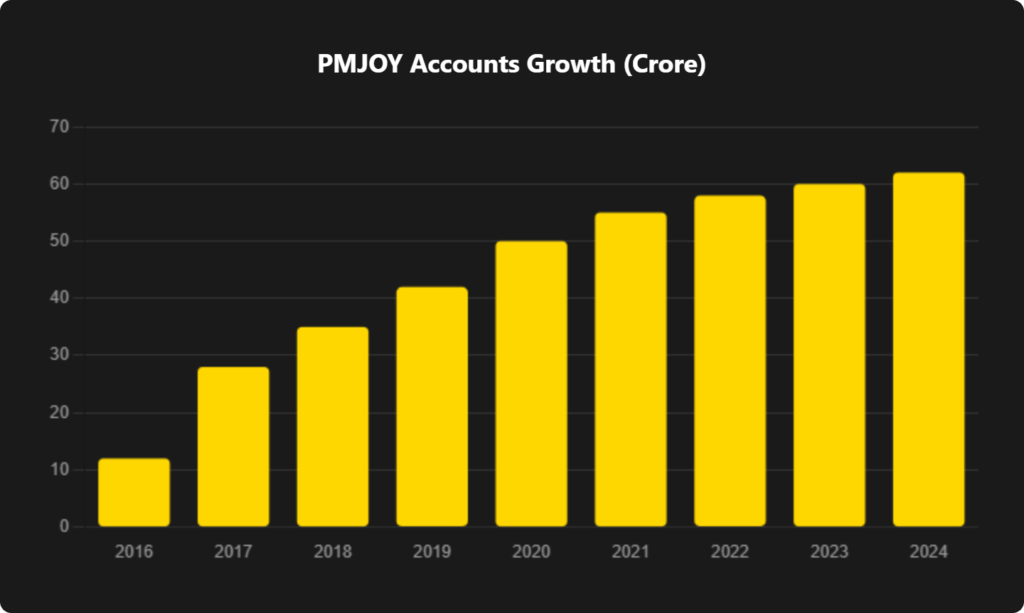
As of mid-2025, roughly 55–56% of all PMJDY accounts belong to women, and about 66–78% are in rural and semi-urban areas — evidence that the scheme is reaching the population it was designed for.
Eligibility Criteria
| Criterion | Requirement |
|---|---|
| Citizenship | Must be an Indian citizen |
| Minimum age | 10 years (minors operate the account through a parent/guardian) |
| Maximum age | No upper limit |
| Income limit | None open to all income groups |
| Existing bank account | Not a barrier you can open a PMJDY account even if you already bank elsewhere, though the scheme is primarily aimed at the unbanked |
| Occupation | No restriction applicable to salaried, self-employed, unemployed, homemakers, students, and daily-wage workers |
Documents Required
If you have standard KYC documents:
- Aadhaar card (preferred, enables instant e-KYC)
- Any one Officially Valid Document (OVD): Voter ID, Passport, Driving Licence, PAN Card, or NREGA Job Card
- Two passport-size photographs (in some banks)
If you don’t have any formal ID (for a “Small Account”):
- A self-attested photograph and signature/thumb impression in front of a bank official is sufficient to open a limited-facility “Small Account,” which can later be upgraded once proper documents are furnished.
How to Open a PMJDY Account
Option A: Apply Offline (Recommended for First-Time Applicants)
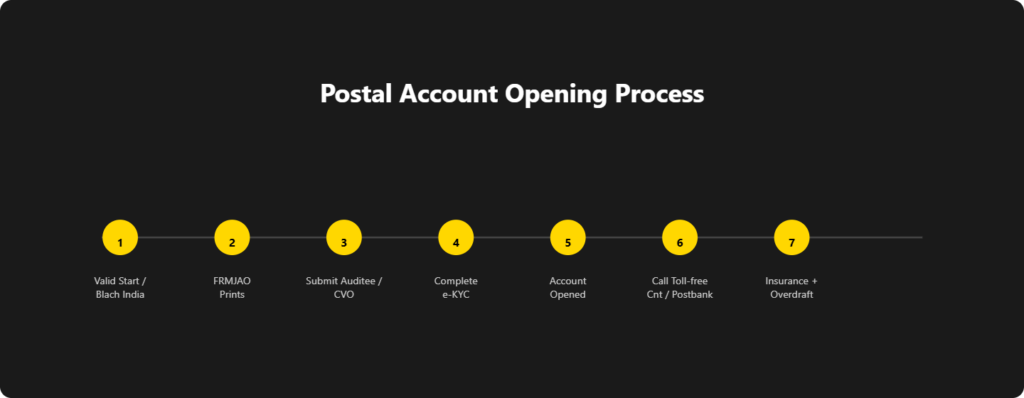
| Step | Action |
|---|---|
| 1 | Visit the nearest bank branch or Bank Mitra (Business Correspondent) outlet in your area |
| 2 | Ask for the PMJDY Account Opening Form (available free, in English and Hindi) |
| 3 | Fill in your personal details name, address, date of birth, nominee details |
| 4 | Attach your Aadhaar card or any other OVD |
| 5 | Submit the form and complete biometric/OTP-based e-KYC |
| 6 | Receive your passbook and RuPay Debit Card (usually within a few working days) |
Option B: Apply Through the Official Portal
- Go to the official website: pmjdy.gov.in
- Download the account opening form from the “Forms” section
- Take the printed, filled form to your chosen bank branch along with KYC documents
- Complete verification at the branch (the account itself cannot be opened fully online physical/biometric KYC is mandatory as per RBI norms)
Overdraft & Insurance Cover Explained
- Overdraft facility: After operating the account satisfactorily for a few months (typically 6 months of regular transactions), account holders become eligible for an overdraft of up to ₹10,000 a small credit line that can be used like a mini emergency loan, repayable with interest.
- Accident insurance: Automatically bundled with the RuPay Debit Card, at no separate premium, as long as the card has been used at least once in the qualifying period defined by the bank/NPCI.
- Life insurance: Applicable only to a specific cohort of early adopters (accounts opened between 15 Aug 2014 and 31 Jan 2015) new accounts do not carry this specific cover, though holders can separately opt into PMJJBY for similar protection.
Common Mistakes to Avoid
- Not linking Aadhaar: Without Aadhaar seeding, you may miss out on DBT payments and faster e-KYC.
- Letting the RuPay card go unused: Some banks require at least one transaction within a defined window to keep the accident insurance active check with your bank.
- Confusing it with a paid scheme: PMJDY is completely free. If anyone asks for money to “open” or “activate” your account, report it this is not an official charge.
- Ignoring the overdraft terms: OD is a loan, not free money it accrues interest and must be repaid.
- Not updating KYC on time: Periodic KYC updates are required by RBI rules to keep the account fully functional.
Pros & Cons
| Pros | Cons |
|---|---|
| Zero balance, zero maintenance charges | Interest rate is the same as any regular savings account not high |
| Free RuPay card with insurance cover | Overdraft limit (₹10,000) is small for larger emergencies |
| Fast, simple KYC via Aadhaar | Life insurance cover only applies to accounts from the 2014–15 launch window |
| Enables DBT for pensions, subsidies, scholarships | Some rural branches/Bank Mitra points can be understaffed during peak periods |
| Access to Mudra loans and pension schemes | Requires periodic KYC re-verification |
Frequently Asked Questions
Q1. Is there any fee to open a PMJDY account?
No. Opening and maintaining a PMJDY account is completely free.
Q2. Can I open more than one PMJDY account?
No, a person should hold only one PMJDY account. If you already have a savings account, you can convert it to a PMJDY-linked account instead of opening a new one.
Q3. What happens if I don’t maintain any balance?
Nothing PMJDY accounts are designed to function with zero balance and do not attract any penalty for it.
Q4. Can a minor open a PMJDY account?
Yes, minors aged 10 and above can open an account, operated jointly with or supervised by a parent/guardian.
Q5. How do I check my PMJDY account balance?
Through your bank’s mobile app, SMS banking, passbook update at the branch, or by using your RuPay card at an ATM.
Q6. Is PMJDY the same as a regular savings account?
It’s a version of a Basic Savings Bank Deposit Account (BSBDA) with added government-linked benefits like insurance cover, overdraft eligibility, and DBT access the core banking functions are the same as a regular savings account.
Quick Links
| Resource | Link |
|---|---|
| 📝 Application Form / Open Account | Click Here |
| 🌐 Official PMJDY Website | Click Here |
| 📊 Check Account / Scheme Status | Click Here |
| 🗂️ Other Government Yojana Info | Click Here |
| 🏠 National Government Home Page (India.gov.in) | Click Here |
| ☎️ PMJDY Toll-Free Helpline | 1800-11-0001 / 1800-180-1111 |